Simone Weil
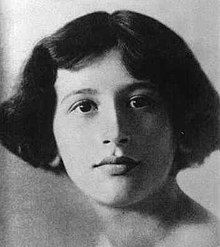
Incarnate Thought and the Mysticism of Redemption
Simone Weil (1909–1943) represents one of the most original and radical figures of the twentieth century: a philosophical and poetic laboratory of the highest caliber, guided by a rare existential integrity. For Weil, philosophy was never pure theoretical speculation, but an experience to be tested firsthand through extreme life choices, aimed at the liberation of the oppressed and the search for authentic spiritual peace.
1. Youth, Teaching and Social Criticism
Born in Paris on February 3, 1909, Simone Weil displayed a profound and highly sensitive personality from an early age. At the age of fourteen, she experienced a severe bout of adolescent despair that brought her close to suicide, a crisis she fortunately overcame. At twenty-one, she began to suffer from the violent and chronic headaches that would torment her for the rest of her days. A student of the philosopher René Le Senne and, with a much more incisive influence, of the thinker Alain, she graduated in philosophy in 1931 and began teaching in provincial high schools (including Auxerre). During these years, she was actively involved in far-left revolutionary movements, despite refusing to join any party. Gifted with an extraordinarily lucid and non-ideological perspective, Simone Weil was among the first intellectual figures to openly denounce the totalitarian tendencies and deviations of the Soviet revolution.
2. The Philosophy of Action: From the Factory to the Spanish Civil War
Her yearning for social renewal and her profound desire to change the world drove Weil to "experiment with herself" outside of university classrooms. Having embraced revolutionary syndicalism, she laid the foundations for a radical antimilitarism and made choices that completely broke with her bourgeois status:
- Factory Experience (1934–1935): In December 1934, he abandoned his books to work as a laborer at Alsthom (a mechanical construction company) and, later, as a milling machine operator at Renault . His diaries bear witness to the merciless hardship, fatigue, and frustration of manual labor. This immersion in the suffering of the poor, combined with a trip to Portugal, marked the beginning of his approach to a radical Christianity, founded on the intimate affinity between the figure of Christ and the poor of the Earth.
- The Disillusionment of the Civil War (1936): In August 1936, driven by an explosive mix of political and religious passion, she left to join the ranks of the anarcho-syndicalists during the Spanish Civil War. Her high moral conscience, however, forced her to make a dramatic realization: she realized that her noble commitment was, in fact, translating into support for a blind and fratricidal massacre.
3. The Mystical Turn and the Years of Resistance
Deeply disillusioned by her Spanish experience, she traveled to Assisi in search of inner peace. There, she experienced a powerful spiritual crisis that defined and consolidated her conversion; from that moment, writing and poetry became a true form of prayer for her. Weil's cultural and spiritual horizons continued to broaden: Encounter with the East Spring 1940 She read the Bhagavad Gita for the first time, receiving a permanent spiritual imprint. On the advice of the great religious historian René Daumal, she began studying Sanskrit to read the sacred text in the original language. Resistance in Marseille Spring 1941 Back in Marseille, she came in